A Child Triumphs Over a Scholar
A Child with Wisdom
The boy was only five years old, but everyone who met him marveled at his wit and wisdom. He was named Yamunait Turaivan.
During this time, a pandit named Alvan claimed to be the greatest scholar in the world. Nobody dared to challenge him because the king regarded him as his guru. Alvan harassed and humiliated other scholars, demanding annual tributes from them, similar to the taxes the king received from his subjects.
The Bold Confrontation
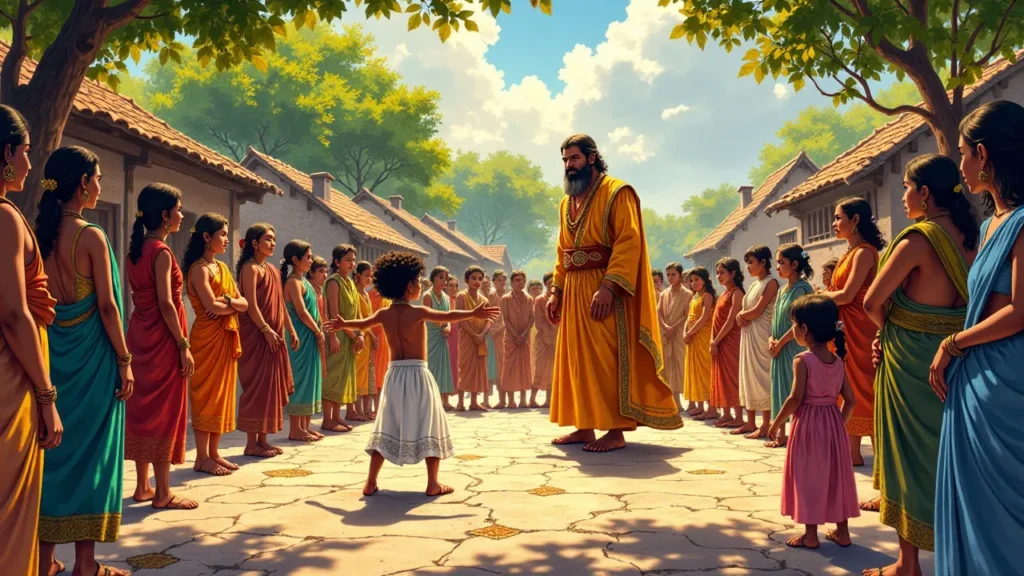
One day, Alvan was passing through the little boy’s village, carried in a palanquin. Drums were beaten and trumpets blown to announce the famous pundit’s arrival. The villagers gathered in the square, where they had to show respect to the pundit, as he was the king’s guru.
However, the procession came to a halt when the little boy stood in the center of the square, spreading his arms to block the way. The villagers had more respect for the boy than for the proud pundit, forming a semi-circle to observe what he would do next. The drums and trumpets fell silent.
The Challenge
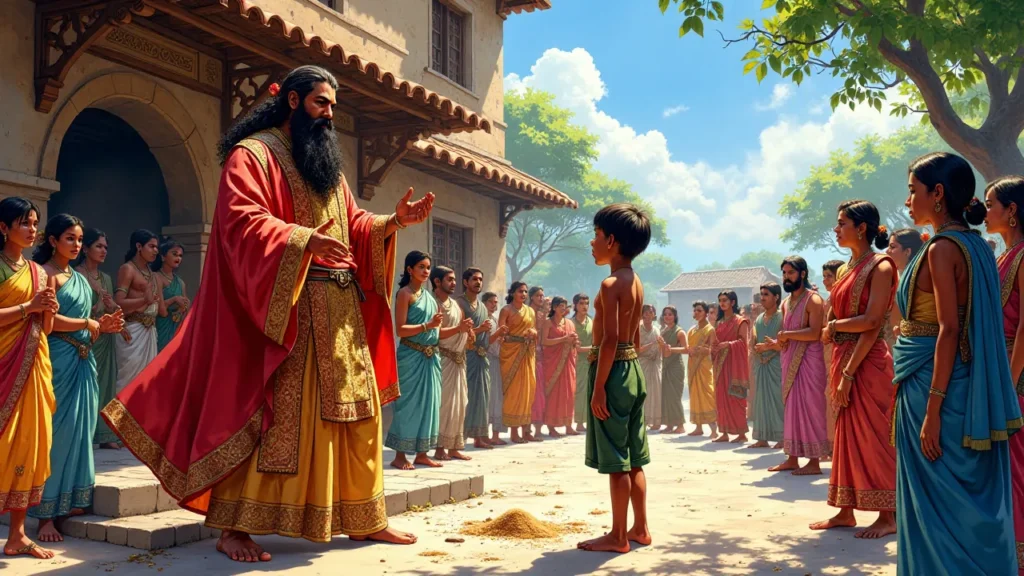
Seeing the child in his way, Alvan instructed his bearers to lower the palanquin. He stepped out and glared at the boy and the crowd. “What do you want?” he asked.
“You claim to be the wisest of all scholars. Will you please answer my question? Then I will let you pass,” replied the boy. Reluctantly, Alvan agreed, feeling awkward but unwilling to appear rude in front of an audience. “What is your question?” he asked.
The boy picked up a handful of sand and asked, “How much sand is there in my grip?” Alvan blinked, realizing he couldn’t count the grains. He felt nervous about this unexpected challenge.
The Outcome of the Rivalry
Chuckling at the scholar’s perplexity, the boy said, “Well, pundit, can’t you just say I hold a handful of sand? All right, you can pass!” The crowd burst into laughter, and Alvan’s face turned red with embarrassment as he retreated into the palanquin.
Later, when the tribute collector came for the boy’s teacher, the boy boldly proclaimed, “My teacher will no longer pay tribute to Alvan. I challenge him to a debate in the king’s presence!” The king, intrigued by the boy’s boldness, ordered that the challenge be accepted.
On the day of the debate, Alvan, shaken with rage, insisted that the boy make a statement. “If I can disprove it, you will receive no penalty,” he demanded. The boy agreed, stating, “Your mother is not childless; the king is free from sin; the queen is married only to the king.” Alvan was stunned, realizing he couldn’t disprove the boy’s statement without implicating himself.
With the crowd cheering, Alvan had to concede defeat. The queen, who had wagered on the outcome, joyfully embraced the boy, calling him Alavandaro—“you are here to rule me.” The boy’s fame spread as Alavandaro, and when asked if he could disprove his own statement, he humbly explained using scriptures and wisdom.
His insights earned him further applause and established a lesson in the value of true wisdom and humility.